

The internet is no longer a library of links; it’s a conversation. Your customers are asking questions, and increasingly, AI is answering them. From Google’s AI Overviews to voice assistants like Siri and Alexa, the way people find information has fundamentally changed.
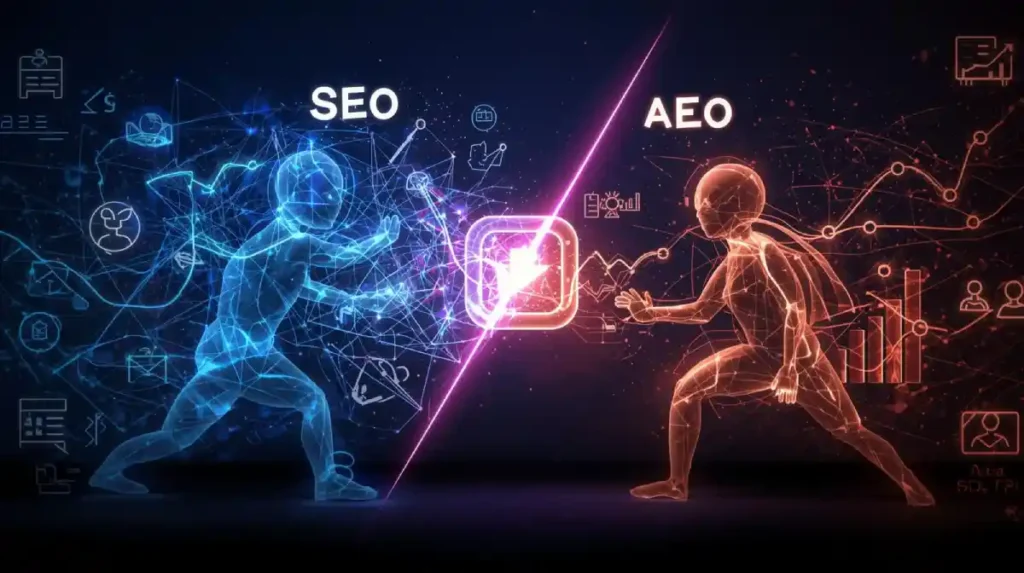
It’s no longer enough to be on the first page of Google. You have to be the answer. This is the new reality of Answer Engine Optimization (AEO). It’s a strategic shift from traditional Search Engine Optimization, focusing not just on ranking, but on providing direct, authoritative answers that AI-powered engines can instantly recognize and feature. For business owners and startups, mastering AEO is the key to future-proofing your content and dominating your niche in the AI-powered era.
At Prodigy Marketing Agency, we’ve distilled this complex field into ten actionable keys. Think of this as your guide to transforming your website from a passive digital brochure into an active, intelligent salesperson that speaks the language of the future.
1. Start with “Why”: Understand User Intent
The foundation of AEO is empathy. You must go beyond the keywords people type and understand the intent behind their query. Are they looking to learn something, compare their options, or make a purchase? Every search falls into one of these categories, and your content must be the perfect answer for that specific need.
Informational Intent: The user wants to know something (e.g., “How does a solar panel work?”).
Commercial Intent: The user is researching before a purchase (e.g., “best solar panel brands 2026”).
Transactional Intent: The user is ready to buy (e.g., “solar panel installation near me”).
Your job is to create content that precisely matches each stage of this journey. A deep dive into user intent ensures you’re not just creating noise, but providing real value at the exact moment your customer needs it.
2. Speak the Language of AI: Use Structured Data & Schema
If you take only one technical step, make it this one. Structured data, or schema markup, is a vocabulary of code you add to your website to label your content for answer engines.
It’s like telling Google, “This block of text is a question, and this is its answer,” or “This is a product, here is its price, and here are its reviews.” This is the single most important step to getting your answers featured. It removes the guesswork for AI, making your content incredibly easy to understand, extract, and present to users. Common schema types include FAQ Page , How To , Article & Product.
3. Ask & You Shall Be Answered: Master the Q & A Format
People ask questions. Your website must answer them directly. The most effective way to do this is to structure your content around the real questions your customers are asking. Use these questions as your headings (H2s, H3s) and immediately follow them with a clear, direct, and concise answer in the first paragraph. This format is exactly what AI looks for. It’s a clear signal that your content is an authoritative answer, making it a prime candidate for featured snippets and voice search results.
4. Aim for Position Zero: Target Featured Snippets
The answer box that appears at the very top of a Google search results page is called the “featured snippet,” or “Position Zero.” It is the most valuable real estate in search. Winning this spot means Google has identified your content as the best possible answer to a given query. To optimize for featured snippets, keep your direct answers between 40 and 60 words. Use formatting like bullet points, numbered lists, and tables to present information clearly. Research the questions in your niche that already trigger featured snippets and craft a better, more direct answer than the one currently featured.
5. “Hey Siri, Find My Business”: Optimize for Voice Search
Voice search is inherently conversational. People don’t speak to their devices in stilted keywords; they ask questions naturally. “Hey Siri, what are the best business podcasts?” or “Alexa, find a top-rated Italian restaurant near me.” Your content needs to reflect this shift. Optimize for natural, long-tail keywords and question-based phrases (who, what, when, where, why, how). Think about how your customers would actually talk about their problems and your solutions, and write content that mirrors that conversational language
6. Be the Go-To Expert: Build Topical Authority
Answer engines are designed to trust experts. To be seen as an expert, you can’t just post randomly. You need to build topical authority by creating deep, interlinked content clusters around your core subjects. Instead of writing one-off articles, think like a librarian building a comprehensive section on a topic. If you’re a marketing agency, create a universe of content around “lead generation,” covering everything from landing pages to email funnels to ad campaigns. This demonstrates a depth of knowledge that answer engines will recognize and reward.
7. Get to the Point, Fast: Create Concise & Scannable Content
AI, like your busy customers, prefers content that is easy to digest. Long, dense walls of text are a deterrent. Your content must be scannable. Use short paragraphs, clear and descriptive headings, bold text for emphasis, and bullet points to break up information. This not only improves the user experience but also makes it easier for AI to parse your content and extract the key information it needs to formulate an answer.
8. Trust is Everything: Focus on E-E-A-T
E-E-A-T is Google’s framework for evaluating content quality, and it’s the bedrock of AEO. It stands for Experience, Expertise, Authoritativeness, and Trustworthiness.
• Experience: Show you have real, first-hand experience with your topic.
• Expertise: Have your content written or reviewed by qualified experts.
• Authoritativeness: Become the recognized, go-to source in your industry.
• Trustworthiness: Be transparent. Cite your sources, showcase reviews, and make it easy for users to contact you.
Building a brand that AI can rely on starts with building a brand that people can trust
9. Look Beyond Google: Optimize for All AI Platforms
The search landscape is no longer a one-horse race. Millions of users are turning to AI chatbots like ChatGPT, Perplexity, and Gemini for answers. Your content is now being surfaced, summarized, and cited on these platforms. Ensure your website is publicly accessible and well-structured so these new answer engines can find and reference your content. Being a primary source for these AI tools is the next frontier of brand visibility and thought leadership
10. Stay Fresh, Stay Relevant: Monitor & Update Your Content
Finally, AEO is not a one-time task. Information becomes outdated, statistics change and better answers merge. Your content must be a living asset, not a static document. Regularly audit your most important pages to ensure they remain accurate, fresh, and valuable. Stale content gets buried by answer engines, while fresh, updated content gets featured. A consistent content maintenance schedule is crucial for long-term success.
Ready to Dominate the Answers?
The shift to an answer-driven world is happening now. By implementing these ten AEO strategies, you can future-proof your content, build unshakable authority, and transform your website into a powerful engine for growth. Start today, and become the answer your customers are searching for. What’s your biggest AEO challenge? The team at Prodigy Marketing Agency would love to hear from you.
FAQs
AEO stands for Answer Engine Optimization, the practice of optimizing content so AI tools and answer engines can easily extract & deliver it as direct responses.
SEO focuses on ranking in search engines, while AEO focuses on providing clear, structured answers that AI platforms can instantly display.
More users now rely on AI assistants and voice search for quick answers, making AI-optimized content essential for visibility.
Clear, concise, well-structured content with direct answers, FAQs & schema markups performs best.
Identify common user questions, answer them directly, use structured headings & add FAQ schema to improve AI readability.