
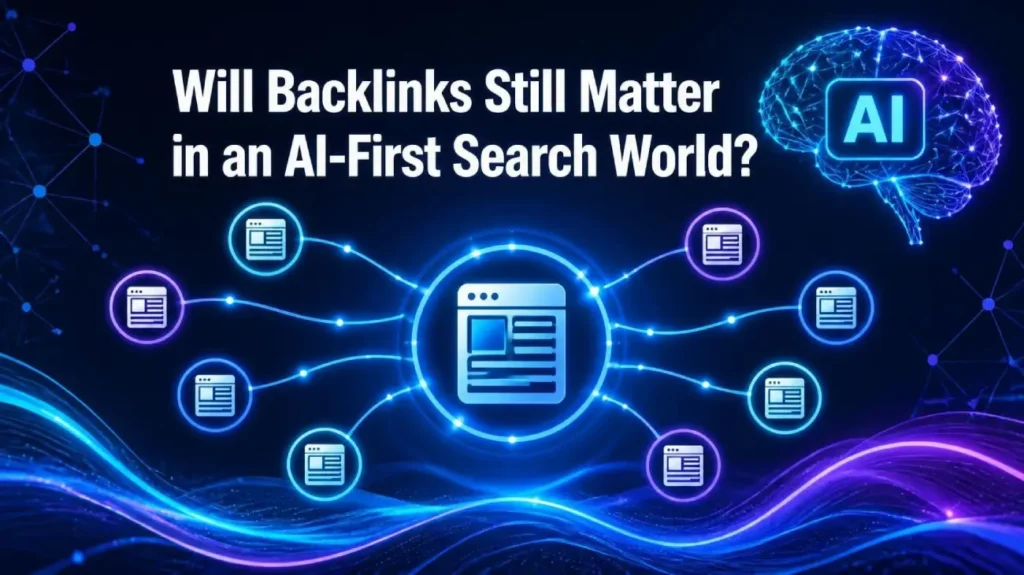
Search is changing faster than most website owners expected. AI answers are now showing up before the usual blue links. People ask longer questions and often get a short answer without opening five different pages. That makes one question hard to ignore: Will backlinks still matter in an AI-first search world? The short answer is yes. But the job of a backlink is changing.
For years, links were treated almost like votes. A good website linking to another site could help search engines optimization understand that the second site was useful or trustworthy. That still matters. What is different now is that search systems have more signals to work with.
At Prodigy Marketing Agency, this shift is hard to miss when looking at how brands build visibility. A page can have a pile of links and still feel weak. Another page with fewer links can get attention because the content is clear, specific and genuinely useful.
Send us "Hi" to start journey of Digital Growth.
Why do backlinks still matter for SEO?
Backlinks still help search engines discover pages, understand relationships and judge authority. A link from a respected industry website can also send real visitors. That part has not suddenly disappeared. The bigger mistake is treating every backlink as equal.
A link from a random directory may add very little. A link from a website that already talks about the same topic can be far more useful. For example, a local accounting firm getting mentioned by a respected finance publication makes sense. A hundred unrelated sites linking to the same firm looks much less convincing. A useful backlink usually has a reason to exist. Good links often come from:
- Relevant industry websites
- News or publication sites
- Helpful resource pages
- Local business and community websites
- Partners or suppliers
- Original research that others want to reference
Are backlinks important for AI search and AI Overviews?
Yes, but probably in a less direct way than traditional SEO. AI search systems need to find reliable information. They do not simply count links and produce an answer. They look at content, sources, entities, reputation and other signals. The exact mix is not fully visible, and it will keep changing. A brand that is mentioned across credible websites has a stronger chance of being understood as a real source rather than just another page trying to rank.
Consider a simple example. A software company publishes a guide about payroll automation. Several respected HR websites mention that guide. A podcast discusses the same topic and names the company. An industry report cites its research. Even if those mentions do not all pass classic SEO value in the same way, they create a pattern. The company exists. It has expertise. Other people know about it. That kind of footprint can matter in an AI-first search world.
What kind of backlinks will matter most?
The useful links are becoming more about context and less about raw numbers. A backlink from a highly relevant page can be more meaningful than several weak links. This is not a new idea. It just becomes more obvious as search gets better at understanding topics.
Here is a simple way to think about link quality:
| Backlink type | Likely value | Why |
|---|---|---|
| Relevant industry article | High | Strong topic connection |
| Trusted local publication | High | Useful for local authority |
| Genuine partner website | Medium to high | Real business relationship |
| General directory | Low to medium | Depends on quality |
| Paid spam network | Very low | Little trust and high risk |
There is no magic number for backlinks. A small business does not need 10,000 links to compete. It may need ten good mentions in places that actually matter. One common campaign is the big guest post push. A company publishes dozens of guest posts in a few months. At first the backlink report looks impressive. Then rankings barely move.
That is usually a sign that the numbers were doing more work than the actual relevance.
Can a website rank without backlinks?
Yes. But that does not mean backlinks are useless. Some pages rank because the topic is easy. Some websites have strong brand recognition. Some pages answer a very specific question better than anything else available. In these cases, a page may gain visibility with very few external links. Still, for competitive topics, backlinks can be a useful advantage.
A practical view is this:
- Low competition topic: strong content may be enough.
- Medium competition topic: content plus relevant links is safer.
- High competition topic: authority, links, brand signals and useful content usually need to work together.
So no, backlinks are not the only path to rankings. They are still one piece of the puzzle.
How should businesses build backlinks for AI-first search?
The best link building often looks less like link building. That sounds strange but it is true. Instead of sending emails asking for a link to a generic service page, create something worth mentioning. Original data works well. So do useful calculators, local studies, strong guides, expert commentary and small research projects.
For example, a real estate company could publish a yearly report on rental prices across ten neighbourhoods. A local newspaper might reference it. Property bloggers might link to it. People searching for rental data may find the report directly. That is a better asset than another page saying why the company is “the best real estate agency.”
Some practical approaches:
- Publish original statistics
- Share useful local research
- Create tools people can use
- Give clear expert comments to journalists
- Build relationships with relevant publishers
- Update old resources so others have a reason to cite them
- Turn customer questions into genuinely useful guides
The strongest links often happen after the useful thing exists. Not before. That is also where Prodigy Marketing Agency can fit into the picture. Link building works better when it is tied to the wider content and brand strategy. A link should support a real reason for someone to trust the business. Otherwise it is just another row in a spreadsheet.
What does backlink quality look like compared with backlink quantity?
Quality usually wins, especially when the links are relevant and earned naturally. Imagine two websites. Site A has 4,000 backlinks from unrelated blogs, weak directories and old guest post networks.
Site B has 180 backlinks. Most come from respected publications, specialist websites, suppliers and industry resources. Site B may have the stronger profile even with a much smaller number.
A basic comparison looks like this:
| Factor | Strong backlink profile | Weak backlink profile |
|---|---|---|
| Relevance | Closely related topics | Random topics |
| Source quality | Trusted websites | Thin or spammy sites |
| Link reason | Useful reference | Forced placement |
| Growth | Natural over time | Sudden bursts |
| Brand mentions | Common | Rare |
This is why chasing a monthly backlink target can be misleading. Ten meaningful links may be better than 100 cheap ones.
Will backlinks become less important over time?
Probably. But “less important” does not mean “unimportant.” Search is moving toward a wider understanding of authority. Mentions, reviews, expert information, brand recognition, content quality and user behaviour can all play a role. AI search makes this broader picture even more obvious.
A backlink may become less like a direct ranking lever and more like evidence. That is an important difference. A company that is mentioned by trusted people, cited by useful resources and discussed in the right places has a stronger digital identity. Links are part of that identity.
What should businesses do about backlinks now?
Do not abandon link building. Just stop treating it as a numbers game. A sensible backlink plan can be quite simple:
- Build content that deserves references.
- Look for websites that are genuinely relevant.
- Focus on fewer strong opportunities.
- Watch brand mentions as well as links.
- Keep an eye on referral traffic.
- Remove or avoid obvious spam tactics.
- Connect link building with PR, content and partnerships.
There is a useful test for every potential link. Would this mention still be valuable if Google did not exist? If the answer is yes, it is probably worth pursuing.
That is a much healthier way to think about backlinks. The search landscape is becoming less about proving that a page deserves a blue link. It is becoming more about proving that a business is real, useful and worth mentioning. Backlinks still have a place in that world. They just have to earn their place.